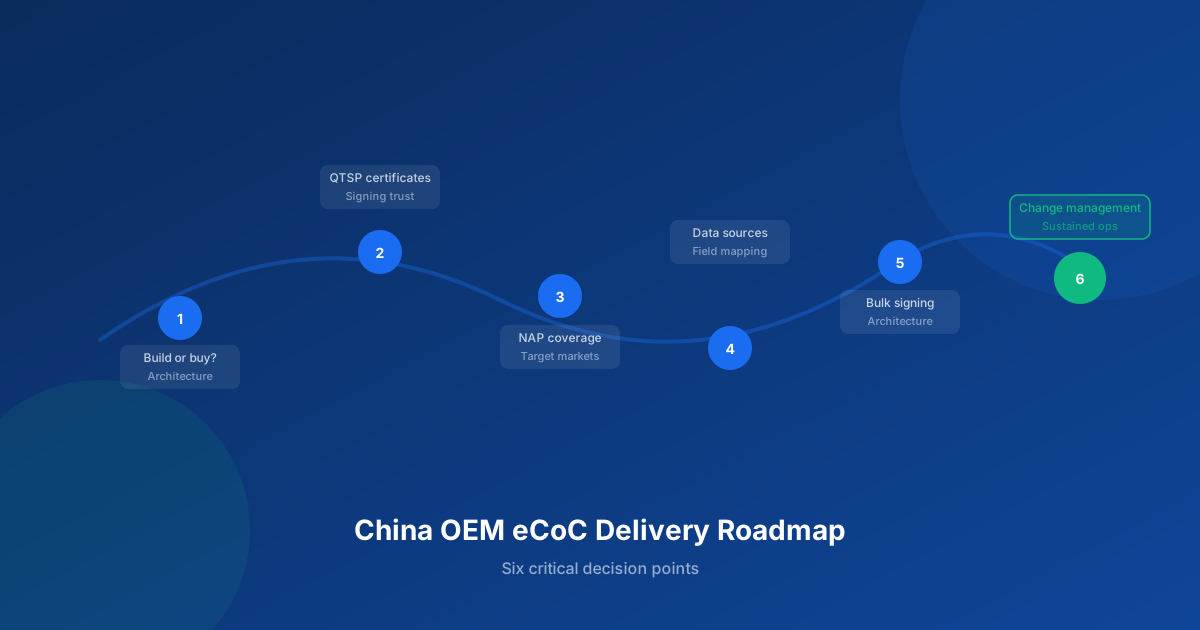
The eCoC Implementation Roadmap for Chinese OEMs Exporting to the EU: Six Critical Decision Points
For Chinese vehicle manufacturers, eCoC implementation is not a pure IT project — it is a systems engineering exercise spanning regulation, digital signing, data governance and integration. This article identifies six decisions that must be made early.
Why a Decision-Point Framework?
Many Chinese automakers begin eCoC projects by jumping straight to technology proposals or requesting platform vendor quotes before fully understanding the regulatory requirements. This order of operations frequently leads to costly rework — a technical design reaches mid-stage only for a critical assumption to collapse, or a procured platform turns out not to cover the target markets.
This article frames eCoC implementation as six distinct decision points, each with a clear set of evaluation criteria, to help executives and project leads establish the right framework at project kickoff.
Decision 1: Build In-House or Adopt an Established Platform?
This is the most foundational — and most consequential — decision.
Building in-house offers full data control, deep customisation and no third-party platform dependency. The cost: development cycles of six months or more, specialist capability requirements (XML signing, NAP integration), and higher upfront investment.
Adopting an established platform can reuse data mapping, signing, submission, and evidence-management capabilities. The trade-offs: data flows through a third party, production onboarding may still depend on the manufacturer's legal identity, and platform exit must preserve original XML, receipts, rules, and audit history. A claim to support “IVI 2.0 / XAdES / NAP” does not prove coverage of the customer's approval authority and registration route.
Guidance: For organisations exporting more than roughly 5,000 vehicles per year to the EU with multi-year expansion plans, a custom or hybrid build is worth serious evaluation. For smaller volumes or urgent timelines, adopting an established platform first — with migration planned for a later phase — is typically the more pragmatic approach.
Decision 2: Which QTSP for the Signing Certificate?
Certificate selection is constrained by several factors:
- Selected NAP acceptance policy: Signer identity, certificate registration, trust-service status, and XML profile must be confirmed against the NAP's written requirements and test results.
- Certificate type: An Electronic Seal certificate (for legal entities) is preferable over a personal signing certificate for automated high-volume signing scenarios.
- Key control: A qualified route carries the corresponding QSCD requirements. Other routes still require controlled keys, authorization, lifecycle management, and audit evidence.
- Lead time: Certificate issuance and NAP registration may both require identity checks. Confirm actual timing with the selected provider and NAP after the route is defined.
Decision 3: Which NAP Will You Use, and How Will You Verify Retrieval?
EU rules allow a manufacturer to use any EU NAP to provide the eCoC to the authority granting the whole-vehicle type approval. The project therefore does not need to integrate separately with every sales country. It needs an available NAP that can onboard the manufacturer and a test showing that the approval authority and registration country can retrieve the record by VIN.
Confirm manufacturer or EU-representative eligibility, transport credentials, test access, signing policy, production gates, receipt handling, incident routes, and downstream retrieval. The UK VCA does not connect to EUCARIS and needs a separate Portal / API route.
Decision 4: Where Does the Data Come From?
An eCoC contains more than 50 data fields distributed across multiple enterprise systems:
- Technical vehicle parameters (engine displacement, dimensions, mass): typically from PDM/PLM.
- Type-approval information (approval number, approval authority): from the regulatory compliance team's records.
- VIN: from ERP / production systems.
- Configuration data (option-dependent technical parameters): may require extraction from BOM systems.
Data integration is consistently the most underestimated workload in eCoC projects. Conduct a "data map" exercise at project initiation: identify the source system, responsible department and refresh frequency for every XML field.
Decision 5: What Is the Architecture for Batch Signing?
For scale exporters, every individual vehicle requires its own eCoC (each bound to a unique VIN), meaning the signing pipeline must support automated, high-throughput processing.
Key architectural considerations:
- HSM deployment model: cloud vs. on-premises HSM, with implications for network latency and availability SLAs.
- Throughput and concurrency: peak periods (such as end-of-quarter bulk shipments) place the highest load on the signing service; capacity planning must account for these spikes.
- Failure recovery and status tracking: the full pipeline from XML generation through signing to NAP submission must be trackable and retryable per vehicle.
Decision 6: How Will Type-Approval Changes Be Handled?
Changes to a type approval (emission standard upgrades, configuration additions) alter CoC data fields. Under the paper CoC regime, template updates are relatively informal. Under eCoC, any change affecting the XML Schema must go through a formal test-and-revalidation cycle.
Establish a type-approval change → eCoC template update standard operating procedure, with explicit ownership assigned across the compliance, IT and quality functions. Delayed template updates result in eCoC data that may fail NAP validation — a risk that escalates as model portfolios grow.
The answers to these six decision points determine your technical architecture, team structure and budget envelope. If your organisation would benefit from an external perspective on any of these decisions, we invite you to book a structured assessment session with our team.
Working on eCoC compliance?
Book a free 30-minute consultation and get a tailored roadmap for your business.