What Is an eCoC? From Paper Evidence to a VIN-Level Data Chain
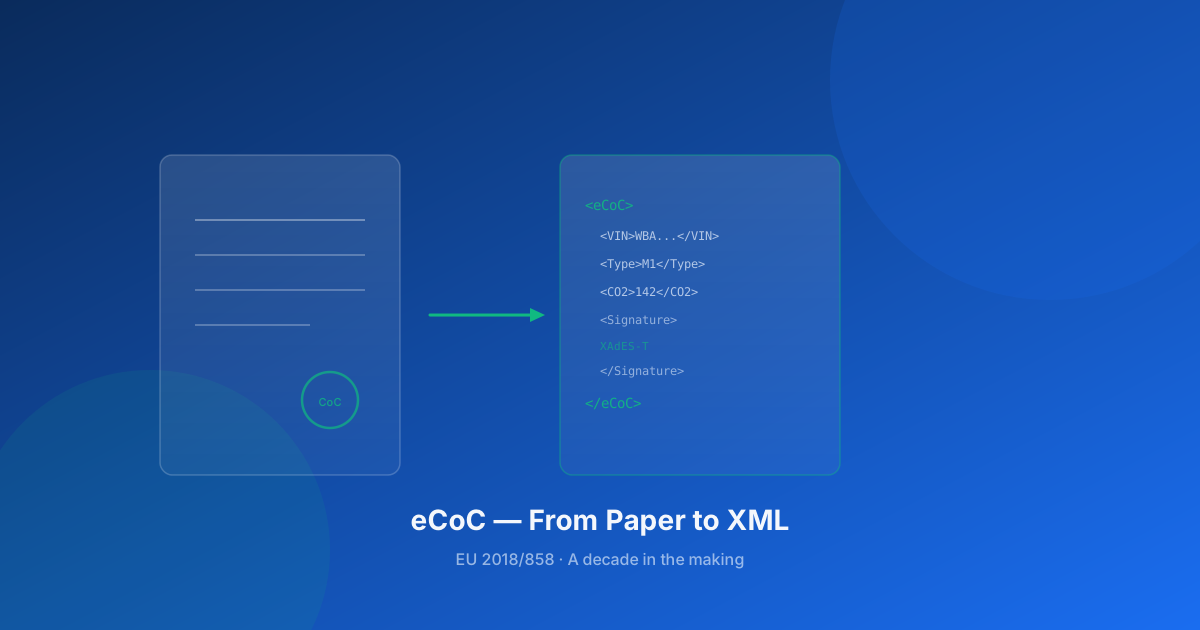
An eCoC is not a scan of a paper CoC. It is structured vehicle data linked to the VIN, type approval, electronic signing, and authority exchange.
What eCoC means
A Certificate of Conformity (CoC) is issued by a manufacturer for an individual vehicle to confirm conformity with its approved type. An eCoC is that certificate in electronic format.
For the formal EU exchange route, an eCoC is not a PDF or scanned document. It is structured vehicle data expressed in XML and exchanged through EUCARIS Initial Vehicle Information (IVI) messages. Each record is linked to a VIN, approval data, and a business version.
This changes four things:
- registration systems can consume structured fields without re-keying them;
- authorities can exchange records or retrieve them by VIN;
- electronic signatures or seals protect origin and integrity;
- a correction must preserve version history instead of overwriting the original file.
Which vehicles are in scope
Regulation (EU) 2018/858 primarily covers M, N, and O vehicles and the whole-vehicle type-approval framework. Applicability still depends on approval route, production date, and national implementation.
Important boundaries include:
- member states may exempt national small series under Article 37(4);
- certain small-series routes may use manual entry or IVI XML upload;
- L-category vehicles fall under Regulation (EU) No 168/2013 and do not automatically share this timeline;
- an ordinary Tier-1 supplier is not normally the legal issuer of the whole-vehicle eCoC;
- a non-EU manufacturer must also resolve its EU representative and type-approval relationships.
The two dates in 2026
July 5, 2026 is the legal Article 37 milestone. Manufacturers must provide structured electronic CoC data to the authority granting the whole-vehicle type approval without undue delay after manufacture, and member states must be able to exchange it.
No later than November 29, 2026 is the boundary of a coordinated operational transition. EUR-Lex did not uniformly amend Article 37 to replace July 5 with November 29. National scope and cutover arrangements in the Netherlands, Sweden, and Ireland also differ.
Projects therefore need to track the legal date, national operating status, and vehicle-specific applicability separately.
The relationship with paper CoCs
Article 36(2) does not establish a permanent paper-plus-electronic dual obligation. Once a manufacturer provides the eCoC under Article 37, the general duty to accompany the vehicle with the paper CoC no longer applies from July 5, 2026.
That does not make every paper document invalid in every situation. National transitions, national small series, special authority requests, and duplicate CoCs may still involve paper. Apply the written rule for the vehicle category, production date, and country concerned.
How NAP and EUCARIS work
Implementing Regulation (EU) 2021/133 allows a manufacturer to use any EU NAP to provide the eCoC to the authority granting the whole-vehicle type approval. Authorities then use EUCARIS for notification, exchange, or retrieval.
EUCARIS is not one central vehicle database. It is a distributed exchange mechanism between national authorities. “Accepted by a NAP” does not mean every country has automatically received the record or can register the vehicle. Operations should verify four states separately:
- NAP acceptance;
- availability to the approval authority;
- retrieval by the registration country using the VIN;
- readiness of the local registration process.
The UK VCA does not connect to EUCARIS. GB / UKNI routes require a separate Portal or API delivery chain.
Signing requirements are route-specific
Implementing Regulation (EU) 2024/1061 requires electronic signing and validation against the eIDAS Article 26 baseline. Whether the implementation uses a signature or seal, whether the certificate must be qualified, and which XMLDSig / XAdES profile applies depend on the selected NAP's current documentation and test results.
EU Trusted Lists can establish the legal status of a trust service at a given time, and DSS can perform cryptographic and policy validation. Neither replaces NAP certificate registration, signer-identity matching, or integration acceptance.
Practical work for Chinese manufacturers
A production eCoC programme normally includes:
- WVTA, configuration, PLM / MES, and VIN data mapping;
- XSD, ICM, internal business-rule, and approval-data checks;
- signer, certificate, key, and signature-profile validation;
- EU NAP or UK VCA accounts, transport credentials, submission, and receipt handling;
- VIN-level retention of original XML, hashes, signing evidence, receipts, and correction history.
The goal is not merely to generate XML. It is to operate a controlled data chain at production scale, detect errors, issue corrections, and support Conformity of Production review.
Official sources
- Regulation (EU) 2018/858
- Implementing Regulation (EU) 2021/133
- Implementing Regulation (EU) 2024/1061
- Irish Revenue: EUCARIS
- VCA: Electronic Certificates of Conformity
Verified through July 30, 2026. A live project must still confirm the selected NAP, approval authority, and registration-country requirements.
Working on eCoC compliance?
Book a free 30-minute consultation and get a tailored roadmap for your business.